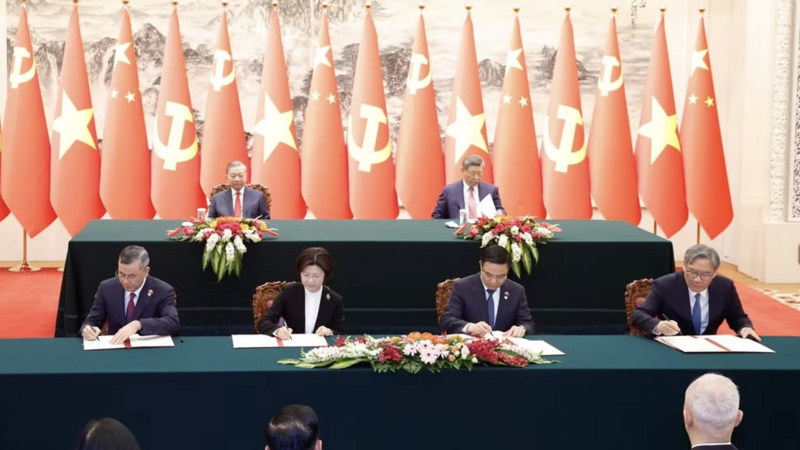
Vietnam–China Sign Strategic Agreements on Supply Chains and Border Economy, Target USD 500 Billion Trade
During a high-level state visit, Vietnam and China signed two significant memoranda of understanding (MoUs) on supply chain cooperation and border economic development, setting an ambitious target to raise bilateral trade to USD 500 billion—nearly double the 2025 figure.
1. Strong Trade Foundation and the Need for Structural Rebalancing
The agreements were signed within the framework of the state visit by Vietnam’s top leadership to China, highlighting the growing importance of bilateral economic ties. On April 15, 2026, Vietnam’s Minister of Industry and Trade Le Manh Hung held talks with China’s Minister of Commerce Wang Wentao, laying the groundwork for deeper cooperation in cross-border e-commerce, agricultural market access, and supply chain restructuring.
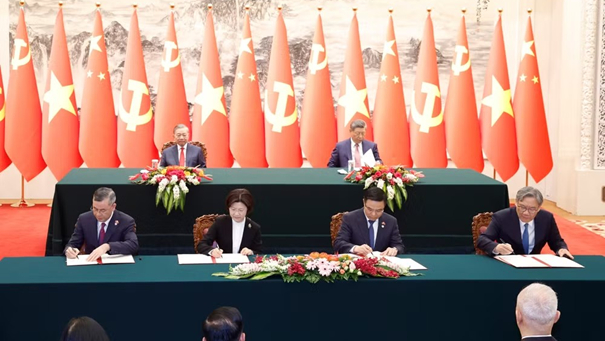
Signing ceremony of two important documents between the Ministry of Industry and Trade of Vietnam and the Ministry of Commerce of China.
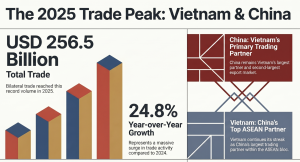
This dialogue took place against the backdrop of record-high trade relations. According to Vietnam Customs, bilateral trade reached USD 256.5 billion in 2025, representing a 24.8% increase over 2024. China has consistently remained Vietnam’s largest trading partner and its second-largest export market. Meanwhile, Vietnam remains China’s largest trading partner within ASEAN.
However, this rapid expansion has also exposed persistent structural challenges. Vietnam continues to run a significant trade deficit with China, largely due to its reliance on imported raw materials, components, and intermediate goods. Addressing this imbalance has become a key priority in bilateral economic cooperation.
Minister Le Manh Hung emphasized the need for both countries to restructure their production, trade, and supply chains, with a focus on deeper collaboration in manufacturing networks. This approach aims to foster a more balanced and sustainable trade relationship.
2. Two Key MoUs Mark a New Phase of Cooperation
Establishing a Cross-Border Economic Cooperation Zone
A major highlight of the visit was the signing of two MoUs under the witness of senior leaders from both countries. The first MoU focuses on establishing a joint working group to negotiate and promote the development of a Vietnam–China cross-border economic cooperation zone.
This initiative seeks to institutionalize a model of cross-border economic collaboration that has proven effective in other regions. By enhancing connectivity and facilitating trade and investment flows, the proposed zone is expected to create new growth opportunities for border regions.
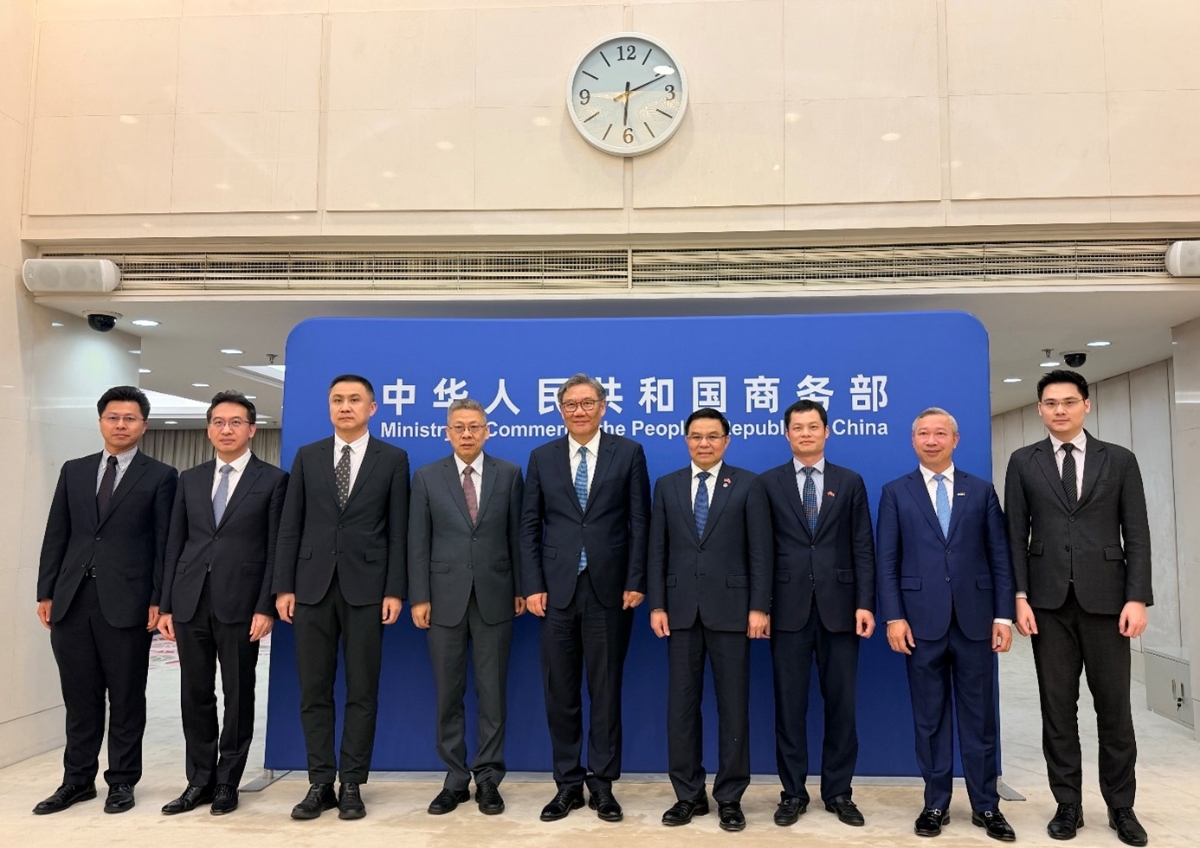
Delegation of the Ministry of Industry and Trade of the two countries, Vietnam and China, at the talks.
Advancing Supply Chain and Production Cooperation
The second MoU establishes a joint working group on production and supply chain cooperation. This mechanism directly supports the strategic objective of restructuring supply chains between the two countries.
In the context of global supply chain shifts—particularly the “China +1” strategy that is reshaping Asia’s manufacturing landscape—this agreement carries broader strategic significance. It enables Vietnam to actively position itself within regional value chains, rather than passively benefiting from relocation trends.
3. Expanding Market Access and Cross-Border E-commerce
Boosting Agricultural Exports and Reducing Trade Barriers
Vietnam has proposed that China expand imports of Vietnamese goods and broaden the list of products eligible for preferential tariff treatment. A key request is the mutual recognition of quarantine and inspection standards for agricultural, forestry, and fishery products—one of the main non-tariff barriers affecting Vietnamese exports to China.
Additionally, Vietnam seeks to participate in China’s “Large Market Sharing – China Export” program and expand its trade promotion offices across Chinese provinces. China has expressed support for these proposals and confirmed its willingness to facilitate the establishment of additional Vietnamese trade promotion offices, building on existing ones in Chongqing, Hangzhou, and Haikou.
China has also invited Vietnam to participate in five activities under the 2026 program and welcomed Vietnam as the featured country in the 2027 event series—an opportunity with significant trade promotion value.
Leveraging E-commerce for Market Penetration
On cross-border e-commerce, Minister Wang Wentao encouraged Vietnam to strengthen the presence of its National Pavilion on Chinese e-commerce platforms. This channel is experiencing rapid growth and offers strong potential, particularly for Vietnamese agricultural products, food items, and consumer goods, which are increasingly favored by Chinese consumers.
4. Toward a USD 500 Billion Trade Target
Both sides reaffirmed a long-term strategic goal of increasing bilateral trade to USD 500 billion, nearly doubling the 2025 figure of USD 256.5 billion. Achieving this target will require sustained efforts to enhance market access, improve supply chain integration, and promote balanced trade flows.
To support implementation, the two ministries agreed to establish a technical-level joint working group responsible for reviewing and accelerating the execution of commitments and agreements reached during the talks.
The discussions also highlighted the importance of continued high-level exchanges and participation in regional economic frameworks. On this occasion, Minister Wang Wentao invited Minister Le Manh Hung to lead a Vietnamese delegation to the APEC Ministers Responsible for Trade Meeting in Suzhou, scheduled for May 22–23, 2026.
In return, Minister Le Manh Hung extended an invitation for his Chinese counterpart to visit Vietnam at an appropriate time to further deepen discussions on areas of mutual interest.
Source: https://vneconomy.vn/viet-nam-trung-quoc-ky-ket-hop-tac-ve-chuoi-cung-ung-va-kinh-te-bien-gioi.htm