FDI Disbursement Hits Five-Year High in Early 2026 Despite Global Uncertainty
Strong growth in new investment projects highlights sustained investor confidence in Vietnam’s long-term prospects
In the first two months of 2026, Vietnam continued to demonstrate resilience in attracting foreign direct investment (FDI), particularly in terms of project implementation. While total registered capital showed a slight decline amid global economic uncertainties, FDI disbursement reached its highest level for the same period in the past five years, reflecting the steady progress of ongoing projects and the continued commitment of foreign investors in Vietnam.
Notably, the number of newly registered projects and newly committed capital both recorded strong growth, suggesting that international investors remain keen to establish a presence in Vietnam as part of broader supply chain diversification strategies. These developments underline Vietnam’s enduring appeal as a manufacturing and investment hub in the region.
1. FDI Disbursement Continues to Grow Positively
Of the USD 3.21 billion in disbursed FDI during the first two months of the year, the manufacturing and processing sector remained the largest recipient, accounting for USD 2.65 billion, accounting for 82.7% of total disbursed capital. The real estate business sector followed with USD 223.5 million, representing 7%, while electricity, gas, steam, and air-conditioning supply reached USD 119.2 million, equivalent to 3.7%.
2. Diverging Trends in Registered Capital
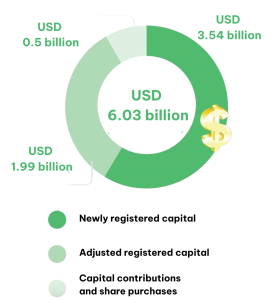
Total registered FDI capital in the first two months of 2026 reached over USD 6 billion, declining compared to the same period in 2025. However, different components of the capital flow showed notable variations.
Newly registered capital recorded strong growth with 620 new projects, up 20.2% year-on-year. The total newly registered capital reached over USD 3.5 billion, representing a 61.5% increase.
In contrast, additional capital for existing projects saw 180 projects register capital increases, down 29.7%, with total additional capital exceeding USD 1.9 billion, a 52.3% decline compared to the same period last year. Meanwhile, capital contributions and share purchase transactions by foreign investors reached 492 deals, a 11% decrease, with a total value of approximately USD 499.4 million, representing a 5.7% year-over-year decrease.
2. Manufacturing Continues to Play a Leading Role
By sector, manufacturing and processing continued to dominate FDI attraction with over USD 4.4 billion in registered capital, accounting for more than 73% of total registered investment. Wholesale and retail trade ranked second with USD 496.4 million, equivalent to 8.23%. Other notable sectors included real estate business (USD 354.3 million), water supply and waste treatment (USD 220.3 million), and information and communications (USD 211.8 million).
Notably, in terms of the number of projects, wholesale and retail trade led for the first time in both new investment projects (accounting for 42.2%) and capital contribution and share purchase transactions (accounting for 40.2%). Meanwhile, manufacturing and processing continued to lead in the number of projects adjusting capital, accounting for 58.3%.
3. South Korea and Singapore Lead in Total Investment Capital
By investment partner, South Korea remained the largest investor with nearly USD 2 billion, accounting for 32.7% of total registered capital. Singapore ranked second with USD 1.9 billion, representing 31.5%. Other major investors included China, Japan, and the Netherlands, with registered capital of USD 807.4 million, USD 256.4 million, and USD 233.8 million, respectively.
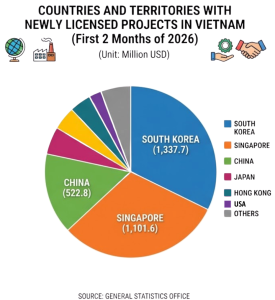
Considering newly registered capital only, South Korea also ranked first with USD 1.34 billion, accounting for 37.8% of newly registered capital, followed by Singapore (USD 1.1 billion), China (USD 522.8 million), Japan (USD 171 million), and Hong Kong (China) (USD 143 million).
In terms of project numbers, China led both in the number of newly registered projects (accounting for 30.9%) and capital contribution/share purchase transactions (accounting for 28.5%), while South Korea ranked first in the number of projects registering capital increases.
4. Thai Nguyen Leads in FDI Attraction
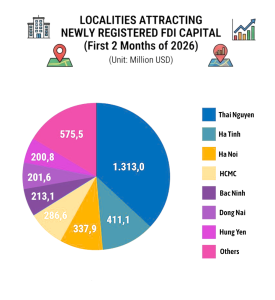
By location, Thai Nguyen Province recorded the largest amount of registered FDI with over USD 1.6 billion, accounting for 27.4% of total registered capital nationwide. Ho Chi Minh City ranked second with over USD 900 million, equivalent to 14.9%, followed by Bac Ninh Province with over USD 818.4 million, representing 13.5%.
In terms of project numbers, Ho Chi Minh City led the country in both newly registered projects (accounting for 52.9%) and capital contribution/share purchase transactions (accounting for 70.7%), while Bac Ninh ranked first in the number of projects registering capital increases (accounting for 30.5%).
5. Notable Investment Projects
During the first two months of the year, several large-scale projects were licensed or adjusted.
- In Ha Tinh Province, the stainless steel manufacturing plant project by Singvin Asset Management Pte. Ltd. and Land River Holdings Pte. Ltd. (Singapore) registered total investment capital of USD 380.1 million.

- In Bac Ninh province, the Seojin Vietnam Factory project (South Korea) increased its investment by USD 453.8 million, bringing the total registered capital to USD 760 million.

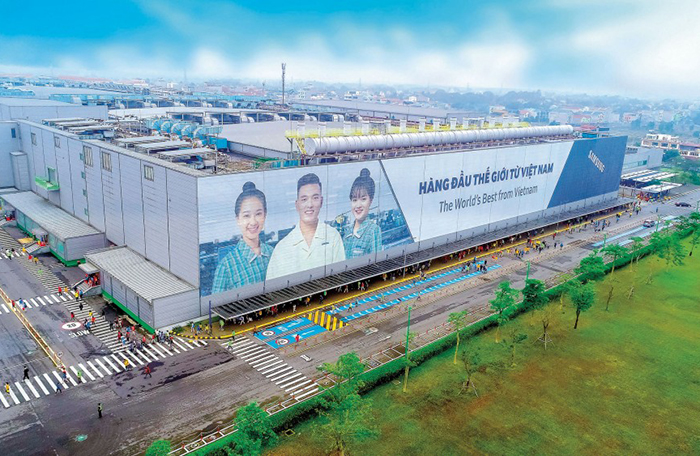
- In Thai Nguyen province, the Samsung Electro-Mechanics Vietnam No.2 project registered USD 1.2 billion in investment capital, focusing on the production of advanced electronic circuit boards.
- In Tay Ninh Province, the Future Textile project by a Singaporean investor also increased its investment by USD 350 million, raising the total registered capital to USD 477 million.
- In Dong Nai Province, the tire manufacturing plant project by HaoHua Vietnam Co., Ltd. registered an additional investment of USD 400 million.

6. FDI Outlook
Global economic conditions, geopolitical, and trade and tax policy uncertainties continue to influence international investment flows, making investors more cautious. This partly explains the decline in total registered FDI capital in the early months of the year.
Nevertheless, several indicators show encouraging signs. Newly registered capital increased sharply by 61.5%, and the number of new projects rose by 20.2%, while FDI disbursement maintained positive growth, reaching over USD 3.2 billion. These developments indicate that Vietnam continues to attract strong interest from international investors as global companies restructure their supply chains. Newly registered projects are generally of small to medium scale, reflecting a gradual and exploratory investment approach. At the same time, existing FDI enterprises, although more cautious in expanding investment scale, continue to implement projects on schedule and honor their investment commitments, reinforcing confidence in Vietnam’s investment and business environment.